
Newport Beach Water Leak Detection
Two houses in this city can be fifty years apart and ten minutes apart. A cottage on the peninsula from before the war, and a build up on Newport Coast from the late nineties. Newport Beach water leak detection has to establish which one it is standing in before it looks anywhere, because the pipe, the layout and the likely failure are all different. A technician reaches you inside 60 minutes.
- 60-min response window
- 24/7 emergency line
- CSLB #920054
Said plainly at the start: water lines are the work. Pool and spa leaks, irrigation, and natural-gas lines sit outside it. A leak behind drywall, above a ceiling, under cabinetry or inside a supply run is ours.
One city, two housing populations, twenty-two years apart.
The Census puts the median house here at 1978, which on its own says very little, because the median hides the split. Newport Coast runs a ZIP code median of 1998, while Balboa Island sits at 1954 and the peninsula at 1962. Those are two separate plumbing populations inside one set of city limits: one on copper that is approaching fifty years of service, the other young enough that the pipe itself is rarely the problem.
Then there is the older tail. Census figures put 7.8 percent of the housing before 1950, and most of it sits on the peninsula and the island. Plumbing in a cottage of that age has been added to and rerouted by several owners across eighty years, so nothing about where a line runs can be read from the outside.
So the diagnostic is not a formality here, it is the job. What a homeowner notices is a bill that climbed with nothing changed, a baseboard staying damp, a mark spreading on a ceiling, a faint running sound once the house is quiet. Each of those points somewhere different, and which of the three populations the house belongs to changes what we check first. All of it happens before a single piece of drywall comes off.
No Callout Charge
The service call costs nothing. No trip charge and no add-on for turning up.
Always On Call
Nights, weekends and holidays included. A pipe that opens at 3am is answered at 3am.
Written Estimates
A written quote with no obligation, walked through line by line before anything starts.
Two eras of plumbing, one diagnostic
Census ZIP medians run from the 1950s to the 1970s on the harbor side and 1998 up on the coast, which means two different failure patterns inside one city. Age takes the older runs. Fittings and connections take the newer ones. The locate tells you which you have.
Naming The Line First
We reach for instruments before tools, every time. The meter establishes that water is being lost, the heater inlet separates hot from cold, we follow the escape along the pipe with amplified listening, and a gauge confirms it. We open nothing to reach that point.
- Loss confirmed at the meter
- Hot and cold separated at the heater
- Findings logged for the claim
Leaks Above The Floor
In a wall, above a ceiling, behind a run of cabinetry. Once we have named the line we put the opening exactly where the pipe is, which matters here because so much of the flooring and millwork in these houses cannot be matched from stock.
- Single access cut, planned from the data
- Ceiling and upper-floor feeds reached from below
- Pressure checked before anything closes
Age Failures On Older Copper
At around fifty years, harbor-side copper thins from the inside and eventually perforates. One pinhole we repair. A run that has produced several is at the end of its life, and we will tell you that rather than sell you another patch.
- Perforation located along the run
- Pressure, age and chemistry all weighed
- Section replaced, or the line replaced
Fitting Failures On Newer Systems
On later construction we often find the pipe sound and the connection not. Flexible connectors, stop valves, heater fittings and manifold connections reach their service age long before the pipe they feed does.
- Connectors and stops replaced, not reused
- Heater fittings and manifolds checked
- System given an honest remaining life
Whole-System Replacement
Where several runs have gone on original copper, we replace the system in PEX and draw a line under it instead of extending the sequence. Where a house is not close to needing that, we tell you plainly.
- Failing runs replaced in PEX
- Phased so the household keeps water
- Pressure regulator verified at the end
Claim Evidence
Adjusters decide on paperwork as much as on facts. We send the locating record, the dated photographs and an itemized scope in the form carriers expect, with the reasoning behind the repair we chose attached to it.
- Cause of loss documented at the visit
- Photographs sequenced and captioned
- Carrier billed direct where the policy allows
How do you find a water leak without breaking anything?
You know water is going somewhere and you cannot say where. That is where almost every call starts, and it is fine, because identifying it is our half of the arrangement. The meter is the first instrument, ahead of any tool. Six steps on, the failed line has a name and an approximate position, with every finished surface untouched.
Diagnosis precedes access, always. That sequence is what reduces the work to a single opening.
Read the meter first
Everything in the house closed, and the dial should be motionless. Any movement means the system is losing water, which is the only thing that needs settling at this stage.
Indoors or beyond the building
Close the main at the house and watch again. A dial that halts places the loss inside. A dial that continues places it between meter and building, or in irrigation. Neither of those last two is ours to repair, but you will know which you have.
Divide hot from cold
Shutting the cold inlet at the heater splits the system in half. A signal that weakens implicates the hot run; one that persists implicates the cold. Floor warmth is not the test, because a hot line does not reliably heat what lies above it.
Listen on the pipe, not through the structure
Valves, heater connections, any reachable run. Floors and slabs absorb the signal and displace where it appears to come from. There is no cross to mark. There is a line to identify so the surface can stay closed.
Prove it with pressure
A gauge on a hose bib, the main shut, the needle observed. A steady fall is independent evidence that water is escaping at that moment, and how quickly it falls suggests the scale.
Thermal, only where it adds
On a hot-side failure beneath a finished surface a thermal pass can settle a remaining doubt. It supports what the acoustics found rather than leading the search, and most jobs never require it.
What are the signs of a hidden water leak?
By the time a concealed leak becomes visible it has generally been running for weeks. What a homeowner actually notices is second-hand evidence, and six things account for nearly all of it. Each points somewhere different.
One is plenty. Nobody gets the full set before calling.
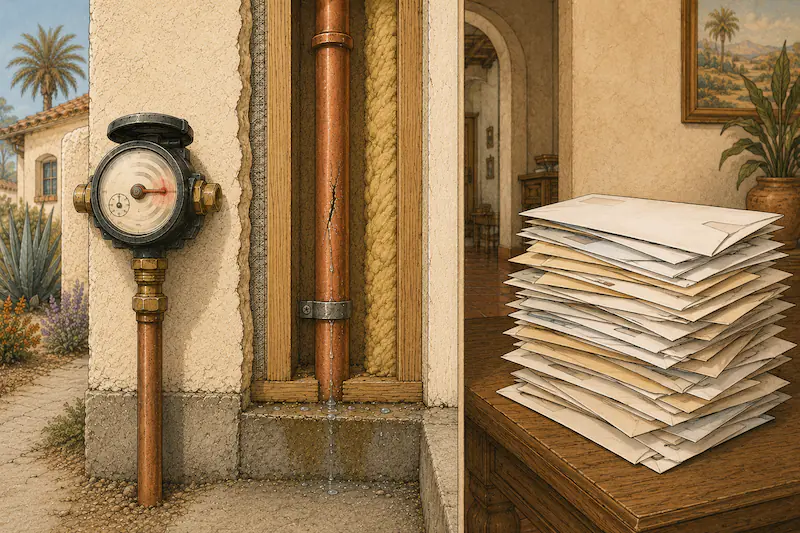
An account that no longer matches the house
Usage unchanged, charge rising regardless. Volume is what makes a leak costly, and volume comes from running continuously rather than from running hard. When the number drifts away from how you actually live, water is going somewhere unbilled to you.
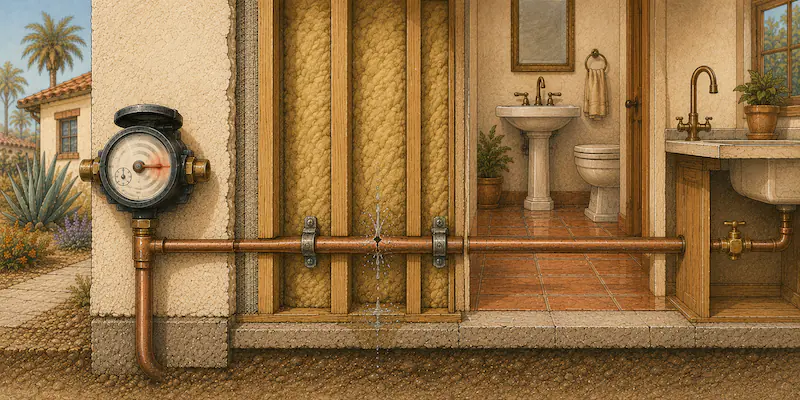
Movement at the meter with everything closed
Turn off every outlet in the house, then watch the dial for a minute. If it creeps, water is leaving the system while you stand there. It is the first thing done on arrival because it settles whether there is anything to look for.

Water you can hear and cannot find
A faint rush behind a wall, or under boards, noticeable only when the place is quiet and nothing is drawing. That noise is water escaping a pipe. It proves the fault exists; it will not tell you where.
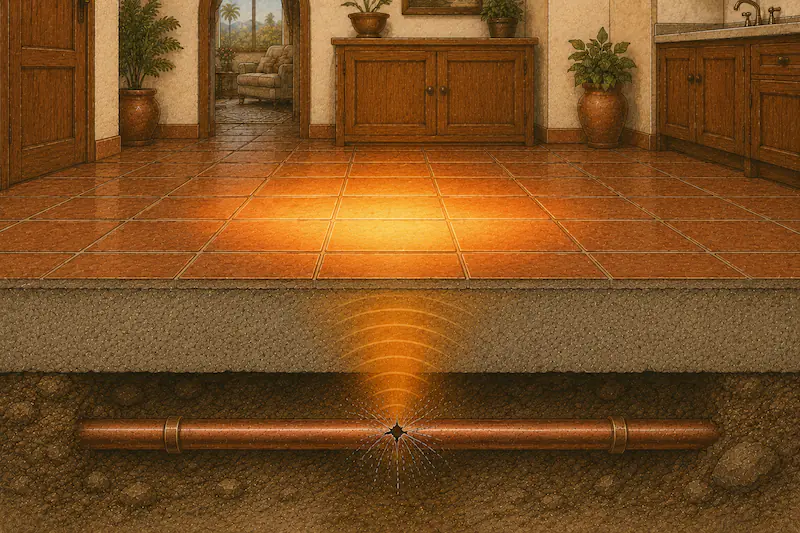
One warm section of floor
Heat in a single patch while the rest of the floor sits cool. Usually a hot run failing below and carrying warmth upward through the surface. It is dismissed as a quirk far more often than it is looked into.
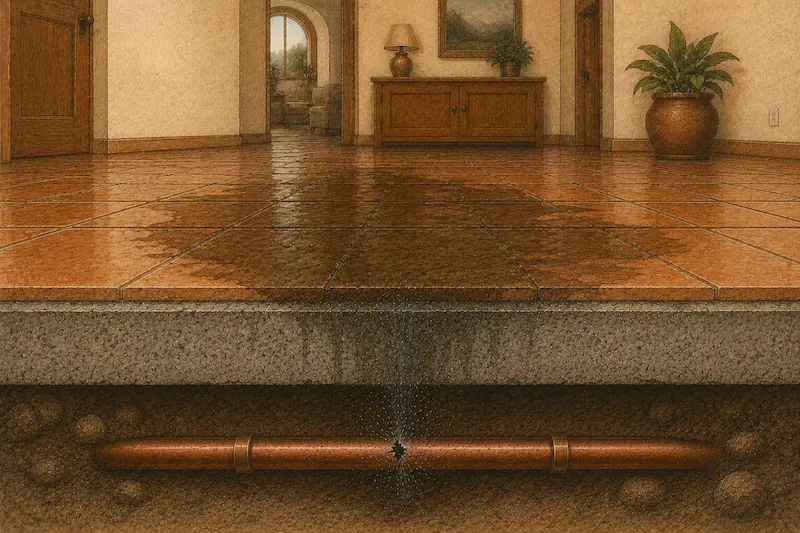
Damp arriving from nowhere
Tile, boards or carpet going wet with no spill behind it, no fixture close by and no weather to blame. Water travels along a slab or sideways out of a wall pinhole and surfaces well away from the failure.
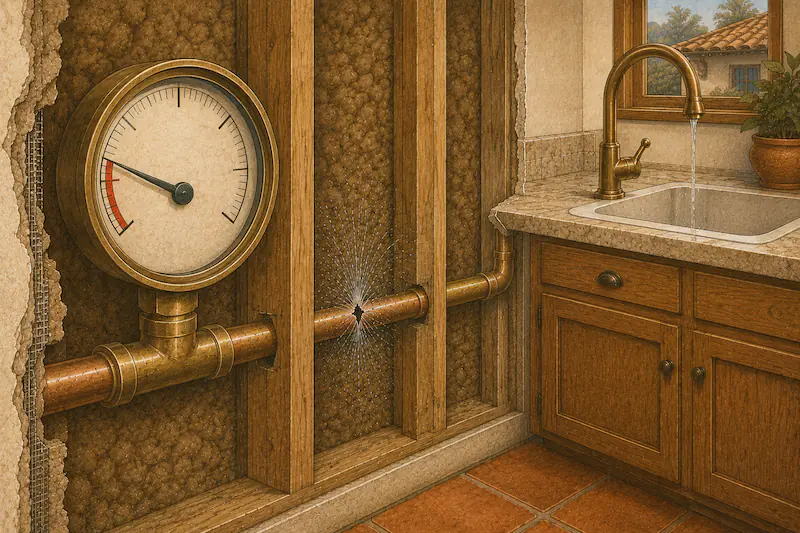
Pressure that slipped without anyone noticing
Less force at the shower and the faucets, with nothing altered at either. Some of the supply is being lost before it arrives. The decline is slow enough that the house gets blamed rather than the plumbing.
Our thanks to the people who keep Newport Beach running.
A 5% discount (up to $200 off) for first responders, military, healthcare, teachers, seniors, and nonprofit staff serving Newport Beach and the surrounding area. Mention "Community Heroes" when you call our dispatch; we'll take care of the rest.
- First Responders
- Military
- Healthcare Workers
- Seniors
- Teachers
- Nonprofit Employees
 First Responders
 Military
 Healthcare Workers
 Seniors
 Teachers
 Nonprofit Employees

Applies to repairs over $500. Cannot be combined with other promotions. Proof of eligibility may be requested at the time of service.
The Newport Beach neighborhoods we take leak calls in every week.
This city is long rather than compact, so we run it the way it is laid out. Pacific Coast Highway carries the length of it, Jamboree Road and MacArthur Boulevard carry the inland side, and Superior Avenue covers the western end. All five ZIP codes sit inside the response window at any hour, peninsula and hillside alike.
Irvine Office
Irvine, CA 92602
Neighborhoods we serve in Newport Beach
The parts of the city we are in most weeks. If yours is close by and not listed, we still cover it, just call.
Leak detection specialists, serving Newport Beach since 2008.
Response window, day or night
The window we commit to on Newport Beach calls, at any hour.
Leaks located and repaired
Hidden water-line, pinhole, and supply-line leaks found and put right.
California License
C-36 Plumbing classification. Bonded and insured statewide.
Leak detection
Free when we do the repair.
What homeowners say about having a hidden leak found.
Verified Google reviews from leak detection and repair jobs handled by the team that serves Newport Beach.
I heard a leak in my wall and within 2 hrs they had someone to my house! Sergio was awesome!
Loved working with Chris! If you have any plumbing issues or needs he's your guy! Worked professionally and was very efficient, would definitely recommend 100%!
I had a great experience with this company. They were timely in their communication and professional. I appreciated how quickly they remediated my home.
We build the claim file. You do not touch it.
The claim file is ours to build and ours to submit. We describe the cause in the carrier's vocabulary, evidence the damage in the order they expect, price the repair element by element, and stay with it from filing to settlement.
It matters because a water loss in a house of any real value gets read closely, and the reading is unforgiving. Anything missing stalls the file rather than delaying it politely.

- How the loss occurred, in writing. The line that failed, the room, the era of the build, phrased for the adjuster reading it.
- The photographic record. The failure, everything the water reached, the access point, the finished repair, dated and ordered.
- Costs broken out element by element, each with the technical reason it was necessary.
- The adjuster hears from us, not from you. Pushback is answered here and further evidence goes over from here.
- Where a reroute is the correct method, the case for it is written out and the diagnostic goes in alongside it.








What leak detection and repair costs in Newport Beach.
The detection is free when we do the repair, so the number under discussion is the repair. The spread is wide and the finish drives much of it: replacing a connector under a sink and reaching a pinhole above a coffered ceiling are different days of work for us. Here are the factors behind the figure.
What sets the repair figure
Where the failure sits
An exposed fitting is quick. A perforation inside a wall or above a ceiling means we make an access cut, replace the length and restore the surface, and those are hours rather than minutes.
Which era the house belongs to
Fifty-year-old copper that has failed once is often worn along its length, which turns a repair into a conversation about the run. Later pipe with a failed fitting usually stays a repair.
What has to be opened and put back
Drywall is straightforward for us. Stone, hardwood and custom millwork are not, and we discuss anything we cannot match from stock before the cut rather than after it.
Access on the property
Tight lots, shared walls, alley access and multi-story layouts all add labor to the same repair. We account for it in the written quote rather than discover it partway through.
Damage that arrived first
Anything already soaked belongs to a separate scope and a different trade. We document it for the claim and keep it off the plumbing invoice.
The little triangle on our water meter keeps turning. Does that mean a leak?
Probably. The city says that with all water off, inside and out, the Flow Finder triangle on your meter should stay still. If it keeps moving, water is going somewhere. That tells you a leak exists, not where it is. Call us, and we’ll trace it to the exact wall, ceiling or fixture.
Our bill went up after the city replaced our meter. Is that a hidden leak?
Not always. The city says most of its old meters were over 20 years old and tended to run slow, so new digital meters can record more water than before. A higher bill may simply be more accurate. Do the Flow Finder test with everything off. If the meter still moves, a hidden leak is likely.
Our home was built before 1950. Why is finding a leak harder in older homes?
Older homes often hide a mix of pipe. Census figures show 7.8% of Newport Beach homes predate 1950, and homes that old have often been remodeled more than once. Lines get extended and joined in odd places. We map how water moves through your home before deciding where the failure sits, so nothing opens on a guess.
We see a damp stain on the ceiling below a bathroom. Where does the water come from?
It’s either the supply pipes or the fixtures above. We pressure test the supply first. If it holds steady, the source is likely a toilet seal, a shower pan or a drain fitting. If the gauge drops, we listen along the pipe to place the pinhole, then open the ceiling only where the repair has to happen.
The water heater runs even when nobody is using hot water. Could that point to a leak?
It might. A leak on a hot line lets heated water escape all day, so the heater keeps firing to replace it. Other signs often join it: a warm spot on a floor, a higher energy bill, or the sound of running water. We split hot from cold to see which side is losing water.
The cabinet floor under our sink has swollen and gone soft. What failed?
Usually a slow drip from an angle stop, a flex supply line or a drain joint. Those parts wear out with age and seep for months before anyone looks under there. We find which piece is weeping, replace it, and test it under pressure. If the leak runs further back into the wall, we trace that too.
What can we do to help before the leak tech gets here?
A few things help. Note when you first noticed the problem, and photograph any stains or damp spots. Clear the area under the closest sinks and around the water heater. If you can, glance at the Flow Finder on the meter with everything shut off. That gives our technician a head start on the search.
Will you document the leak for our homeowners insurance?
Yes. We photograph the locating readings, the access opening, the failed pipe and the finished repair, and each photo is dated. We write the cause of the leak in plain terms an adjuster can act on, send the file to your carrier, and handle their follow-up. Dry-out of any wet materials is a separate scope.
Do we pay for the leak search if you also make the repair?
No. Leak detection is free when we do the repair, and there’s a $0 trip charge. After we find the leak, you get a written quote for the fix, and work only begins once you approve it. Community Heroes, such as teachers and first responders, get 5% off, up to $200, on repairs over $500.
After you find the leak, do you fix the pipe or replace the whole run?
That depends on what the pipe tells us. A single pinhole in otherwise sound copper gets a short section swapped. A run that has failed in several places is near the end of its life, and patching it again rarely holds for long. We explain which case you’re in and put both options in writing.
Can you find a leak behind cabinetry or built-ins without pulling them out?
In most cases, yes. We listen along the pipes from places we can reach, such as valves, the heater and open runs, and confirm the loss with a pressure gauge. Once we’ve placed the failure, we plan the smallest opening near it. Custom millwork stays in place unless the repair truly needs it moved.
How do I confirm your license before letting you in?
Look up CSLB license #920054 on the California contractors board website. It belongs to Cali’s Choice, which has found and fixed hidden leaks since 2008. Our technician can show the license when they arrive, and they will walk you through each step of the search before any tool comes out.
Suspect a hidden leak in Newport Beach? We're 60 minutes away.
A real technician in a stocked truck, and a written estimate before anything is opened. If the job is not ours, we will tell you whose it is.
3943 Irvine Blvd, Ste 419 · Irvine, CA 92602 · CSLB #920054