
Water Leak Detection
You can tell there is a leak. What you can’t tell is where it is or what kind it is, and guessing is how floors get torn up for nothing. That is what detection settles first. We pinpoint hidden leaks behind walls, above ceilings, under fixtures, and inside pressurized copper, without opening a single surface, then show you exactly what the repair involves. Find it, then fix it, in that order, every time.
- 60-minute response
- 24/7 emergency line
- No demolition to locate
- CSLB #920054
Heads up: We’re water-line specialists. We don’t service pool/spa leaks, irrigation lines, or natural-gas lines. Everything else hidden behind walls, under sinks, or in the ceiling, that’s exactly what we do.
What is water leak detection?
Water leak detection is the non-invasive process of locating a hidden water leak, behind a wall, under a floor, above a ceiling, or inside a pressurized supply line, before any surface is opened. It works by elimination rather than excavation: a sequence of diagnostic tests, a meter reading, line isolation, acoustic listening through the pipe, and a pressure check, narrows the fault to one line and one area, so the repair that follows is targeted instead of exploratory. The point of detecting first is simple, you only open what the diagnostic tells you to.
No Callout Charge
Your service call is free. No trip charges, or surprise add-ons.
Always On Call
Nights, weekends, holidays – we are available around the clock. Burst pipe at 3am? No problem.
Written Estimates
No-obligation written quote. We walk you through every line item.
Six shapes a concealed leak takes, and how each one is put right.
A hidden leak shows up in a handful of recognizable forms. Locating runs first on all of them, since the failed line has to be pinned before any repair is more than a guess. Once it is, one crew carries the work through, from a single weeping joint to a whole run that has earned replacement.
Pinpoint locating
The read that opens every visit. Watching the meter, splitting hot from cold, tracing the sound along the pipe, and confirming on a pressure gauge tells us which line gave way and roughly where, with no surface disturbed. A thermal camera joins in only to settle a close call.
- Hot and cold lines checked under pressure
- Behind-drywall and attic-feed tracing
- Findings photographed for your claim
Behind-wall and overhead fixes
With the line pinned, we cut only where the read sends us: a tight opening to reach a weeping joint inside a wall, or a fix on a feed dripping down from the story above. Sparing the drywall around it is the point, not collateral we shrug off.
- Tight openings that protect intact board
- Overhead feed-line work
- Re-pressurized and checked before sealing
Tired copper and its weeping points
Thin copper that has carried hard pressure for decades begins to seep at tiny spots. We renew the spent stretch rather than the entire run, and hold off on more until the line itself signals it is finished.
- Spot tracing along copper runs
- Why-it-went read: pressure, chemistry, years
- Stretch renewal or a partial repipe
Shutoffs, fixtures, and feed lines
Seepage at an angle stop, beneath a sink, behind a toilet, at the laundry box, or along the line feeding any fixture. We trace each one back to its origin and correct it there, without test cuts to find it.
- Angle-stop and feed-line work
- Under-sink and fixture seepage
- Confirmed under pressure at close
When renewing the run beats patching
Once the same copper keeps seeping, the next patch is money chasing the last one. Swapping the spent stretches for PEX ends the cycle for good, and we say so plainly the moment the arithmetic turns against another repair.
- PEX standing in for spent stretches
- A frank repair-or-renew verdict
- Regulator pressure reviewed
Carrying the insurance file
We assemble the locating record, dated images, and a loss scope phrased the way an adjuster reads, drawing on years across every major homeowner policy. You are not left piecing the evidence together on your own.
- Documented cause of loss
- Carrier billing where permitted
- Scope written in carrier terms
How do you find a water leak without breaking anything?
You know there’s a leak, you just don’t know its kind or its place: in-wall, ceiling, pinhole, behind a cabinet, or a buried supply line. Detection is a process of elimination before it is ever a search. Each step is a yes-or-no test that cuts the possible fault area roughly in half, so by the time anyone listens for the leak itself, the question has narrowed from somewhere in the house to this line, this side, about here. We confirm a hypothesis, we don’t hunt blind, and that is the whole reason it can be done without opening a wall.
The order is deliberate, cheapest and least invasive test first, because each one rules out an entire category of problem before the next begins. Run it out of order and you are guessing with a saw. Run it in order and, by the time anything is opened, we already know the failed line and roughly where it sits. That is the difference between one access cut and a room full of demo.
Read the meter first
Before a tool comes off the truck, we watch the water meter with every fixture and appliance shut. The meter is a flow gauge on the whole-house feed, so it answers one question with no instruments: is this closed system holding or losing water? Still means it holds, and a leak is ruled out. Creeping means water is leaving the system, and only then is there a leak worth finding.
Inside the house, or outside it?
We close the main valve at the house. The main is the boundary between two completely different jobs, so settling the side first keeps us from chasing the wrong system. If the meter goes still, the loss is inside the home. If it keeps turning, it is in the service line or the irrigation outside, which we don’t repair, but we will tell you plainly what you are dealing with.
Hot side or cold side?
At the water heater we close the cold inlet. Starting here is playing the odds, not guessing: hot lines tend to fail first, because heat speeds copper’s corrosion and the constant expand-and-contract of hot water works the pipe against whatever holds it. If the leak signal eases, it is a hot-line leak; if it holds, it is cold. A warm floor is a hint, not proof, because a hot line doesn’t always warm the surface above it, so we trust the acoustic read over the bare foot.
Listen through the pipe, not the wall
This is the part most people picture wrong, and it is a method choice, not a preference. Drywall and concrete are dense, so they deaden and scatter a leak’s sound, and listening at the surface gives a smeared reading that points everywhere at once. The pipe is a continuous metal path that carries the leak’s hiss cleanly to any point we can reach, a shutoff, the heater, a hose bib, and because the sound travels along the metal it also tells us which line is carrying it. We read the material that conducts the signal, never the one that muffles it.
Confirm it under pressure
Acoustics can be fooled, by a noisy house, by more than one suspect on the line, so we never open anything on a single signal. We cap a gauge onto a hose bib, close the main, and watch the needle. A steady fall is a separate physics that proves the system is actively losing water no matter what we heard, and the speed of the drop estimates how fast. Two independent signals agreeing is what lets us cut one spot with confidence.
Add a thermal pass when it earns its place
Thermal reads surface temperature, which is only a proxy: it works on a hot-line leak under a conductive floor or wall and is easily thrown off by sun, appliances, or a radiant heat path. Lean on it as the primary locate and it will send you opening the wrong surface, so we keep it as a tiebreaker that confirms the acoustic read, never the thing a cut is based on.
What are the signs of a hidden water leak?
Hidden leaks rarely announce themselves. By the time water shows up somewhere you can see it, the leak has usually been running for weeks, often far from where it surfaces. These are the signs homeowners notice first, and, more useful, what each one is actually telling you about the leak underneath it.
You don’t need all six. Any single one is reason enough to call, because each points at a different failure and a different next test.
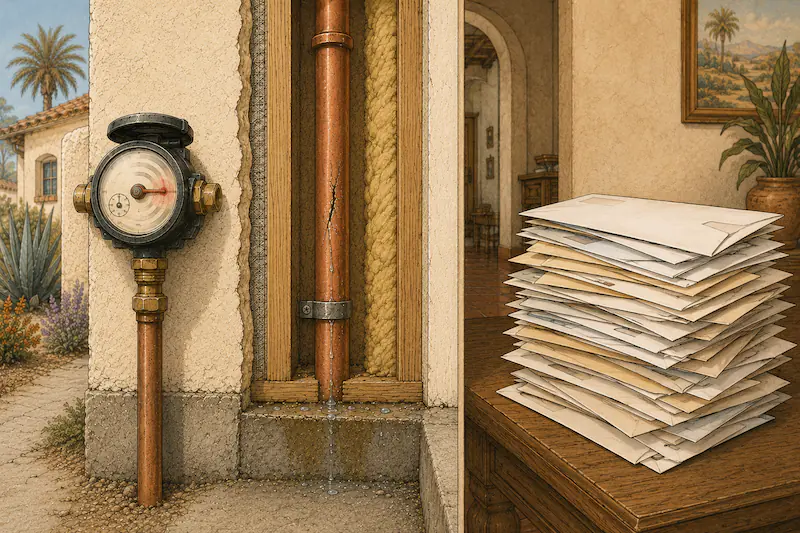
A water bill that climbs with no change in habits
A hidden leak runs every hour of every day, so the bill is really a running total of waste over time. That is why a drip too small to hear can still add hundreds of dollars a month: the size barely matters once you multiply it by twenty-four hours. If your usage hasn’t changed but the number keeps rising, the gap is water escaping before it reaches a fixture.
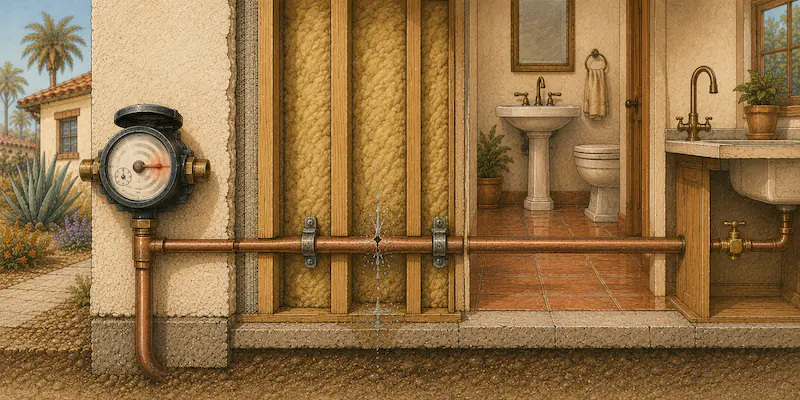
The meter moving with everything shut off
Turn off every faucet, appliance, and fixture, then watch the meter dial. It sits on the whole-house feed, so with nothing drawing water, any movement at all is unaccounted flow somewhere downstream of it. This is the single most definitive at-home check, and it is the first one we run, because it proves within minutes whether a leak exists before we spend time finding it.
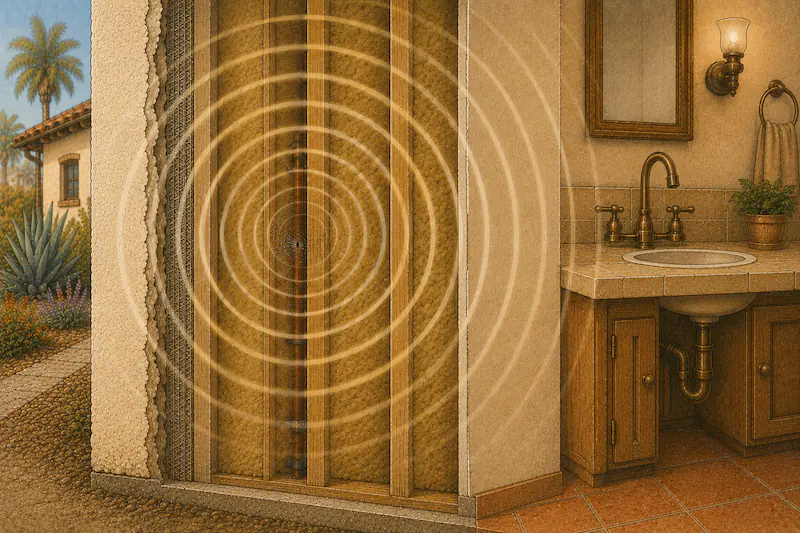
Running water you can hear with nothing on
A faint hiss, trickle, or rush behind a wall or under the floor is turbulence at the leak itself, water forcing through an opening it shouldn’t. You can hear that it is happening, but not where, because the pipe carries the sound away from the source along its whole length. The sound confirms the problem; locating it still takes listening at the pipe, not at the wall.
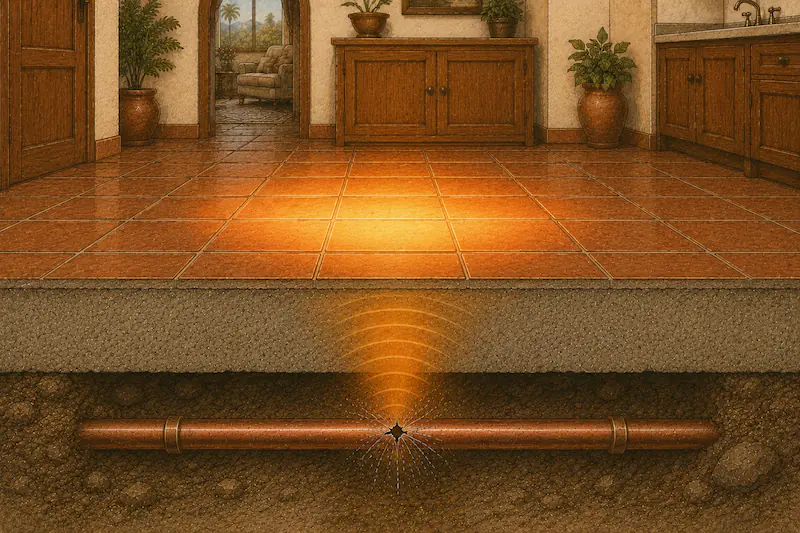
A warm patch on the floor
A spot warmer than the floor around it usually means a hot-water line is leaking below, with the heat conducting up through slab or flooring. Worth knowing: the reverse doesn’t hold. No warm spot does not clear a hot leak, because depth and floor type can hide the heat entirely. That asymmetry is exactly why we confirm the side acoustically instead of trusting what the floor feels like.
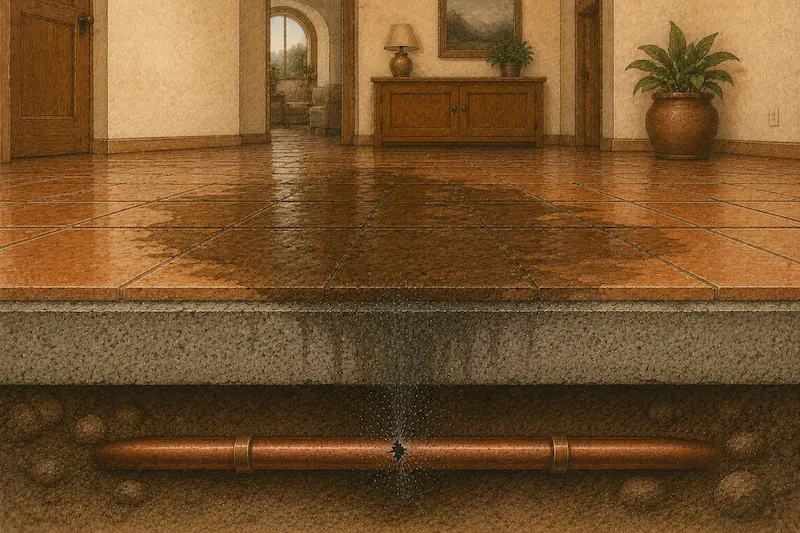
Damp flooring with no source nearby
Moisture in carpet, wood, or tile with no spill, fixture, or rain to explain it is water that has traveled. It follows the path of least resistance, so the wet patch is often a good distance from the actual leak. That is the trap in cutting where it looks wet: you can open the floor in the wrong place entirely, which is why the wet spot is a clue to investigate, not a target to dig.
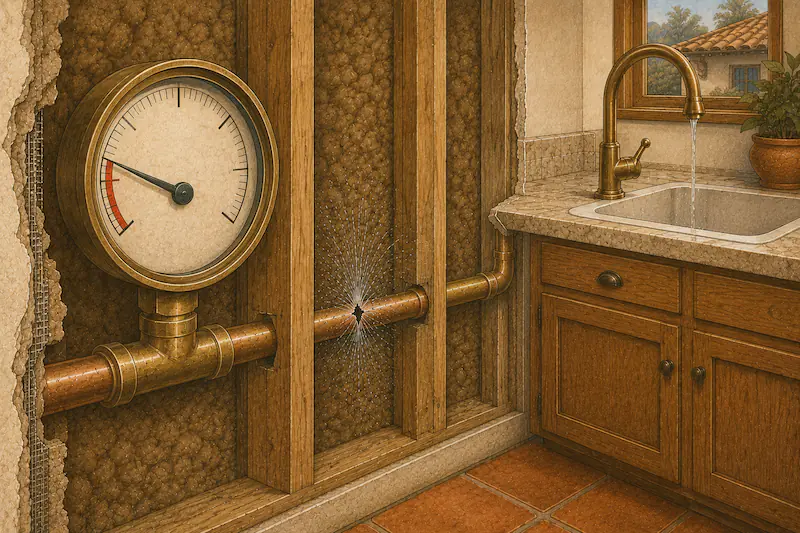
Water pressure that has quietly dropped
If shower and faucet pressure faded but nothing about your fixtures or service changed, water is likely bleeding out of the system before it reaches the tap. Leak-driven pressure loss comes on gradually, which is why it so often gets written off as old pipes instead of an active leak draining the line in the background.
Our thanks to the people who keep our communities running..
A 5% discount (up to $200 off) for first responders, military, healthcare workers, teachers, seniors, and nonprofit staff in the communities we serve. Mention "Community Heroes" when you call; we’ll take care of the rest.
Applies to repairs over $500. Cannot be combined with other promotions. Proof of eligibility may be requested at the time of service.
Water leak detection in your city
We dispatch from offices across Southern California. Pick your city for local response times, neighborhoods, and the team that serves you.
Leak detection specialists since 2008.
Response window, day or night
Dispatch-to-driveway target for emergency calls, around the clock.
Hidden leaks located
Behind-wall, pinhole, ceiling, and supply-line leaks found and repaired.
California License
C-36 Plumbing classification. Bonded and insured statewide.
Leak detection
Free when we do the repair.
What homeowners say about finding hidden leaks.
Real reviews posted to our Google Business Profile.
I heard a leak in my wall and within two hours they had someone at my house. Sergio was awesome, found it fast and sorted it out.
Sergio came out on a Saturday evening for a leak in my ceiling. I was very pleased with the response time and the quick fix. I would definitely recommend these guys.
Great knowledgeable team. They found the issue and helped me find a resolution quickly. No guesswork, no mess.
A hidden-leak claim rests on evidence you can only capture once.
A hidden leak is, by its nature, something nobody saw coming, so the moment it is exposed is the one chance to document it. Once the wall is patched and the area dried, an adjuster has nothing left to assess but your description of it. The covered damage is usually granted; the friction lands on the repair, whether a patch or a full repipe on tired copper is the choice the carrier will pay for.
So we build the file at the point of detection, while the failed pipe and the moisture path are still open, then run it to the carrier ourselves, so the claim is decided on documented fact rather than reconstructed from memory after the wall is closed.

- Cause documented at the source. A hidden leak gives one window to record what failed and why, the pinhole, the line, the path the water took, before any of it is sealed back up and put beyond an adjuster’s reach.
- Sudden and accidental, set down in writing. Coverage turns on that finding, so the file states how the line failed and when: the difference between a paid claim and a wear-and-tear denial on old copper.
- Repair versus repipe, argued not assumed. When tired copper makes a repipe the smarter repair than another patch, the scope makes that case with the diagnostic behind it, so the lasting fix isn’t denied in favor of the cheaper one.
- The carrier conversation is ours to carry. We field the adjuster’s questions and evidence requests directly, so you are not relaying technical detail about a leak you never actually saw.
- A photo record that reads as proof. The locating data, the open access point, the failed line, and the finished repair, dated and captioned, so the claim is a documented sequence rather than a written description.








What water leak detection and repair actually costs.
The honest answer is that no website can quote you a number. The same hidden leak can become very different jobs depending on what we find: where it sits, how hard it is to reach, and whether it’s one fitting or a failing run. What we can do is lay out exactly what moves the price, so the written quote reads as logic, not a number from the air.
What moves the cost up or down
Where the leak turns out to be
A leak at a reachable shutoff or water-heater connection is one kind of job. A line buried deep behind tile or under the middle of the house is another entirely.
What the repair takes
A spot repair on accessible copper is the quickest path. A full reroute through walls and attic costs more upfront but holds up far better on aged plumbing, which is often the more honest long-term call.
Pipe material and age
Older copper often shows wear along the whole run, not just at the pinhole, which can move the recommendation from a spot repair toward a reroute or repipe.
How reachable it is
Tile floors, second-story leaks, tight attic clearances, and finished interiors all add labor time to reach and to close back up cleanly.
Damage already done
If the leak has already soaked drywall or flooring, drying and rebuild is a separate scope handled by a sister company. We document it for your claim and keep it off our repair number.
What is water leak detection?
It is the work of locating a hidden water leak without opening anything: behind a wall, under a floor, above a ceiling, or inside a pressurized supply line. Instead of cutting to look, we run a sequence of tests, a meter reading, line isolation, acoustic listening, and a pressure check, that narrows the leak to one line and one area, so the repair can be aimed instead of exploratory.
I don't know what kind of leak I have. Can you still help?
That is exactly when to call. You don’t have to diagnose anything yourself, that is the job. A high water bill, a damp baseboard, a ceiling stain, a warm spot on the floor, a hissing wall, every one of those is a reason to start with a detection visit. We work out which line is leaking and where, then show you what the fix involves.
How do you find a leak without breaking the wall or floor?
We start at the meter to confirm water is escaping, then isolate the hot side from the cold at the water heater. From there we listen acoustically through the plumbing itself, at shutoffs, the heater, and reachable runs, not through the wall, which only muffles and scatters the sound. A pressure test confirms the leak is active before anything is opened.
What kinds of leaks do you detect?
Every kind of hidden in-home water leak: in-wall pinholes, ceiling drops from upstairs supply lines, leaks behind cabinetry, copper pipe failures, and supply-line and fixture leaks. We don’t handle pool, spa, irrigation, or gas. A leak buried in the slab is its own specialty, covered on our slab leak repair page.
What are the most common signs of a hidden leak?
A water bill that climbs with no change in habits, a meter that keeps moving with everything shut off, the sound of running water when nothing is on, a warm patch on the floor, damp flooring with no nearby source, or a quiet drop in water pressure. Any one on its own is worth a call, since each points to a different failure.
How accurate is acoustic leak detection?
Accurate enough to open one spot instead of exploring, which is the whole point. We don’t rely on a single signal: the acoustic read tells us which line and roughly where, and an independent pressure test confirms the system is actively losing water. When two methods that work differently agree, the locate is something we’ll act on, and thermal imaging settles the rare close call.
Do you repair the leak the same day you find it?
Usually, yes. Most hidden leaks we locate, an in-wall pinhole, a supply-line failure, a ceiling drop, we can repair on the same visit once you approve the written quote. Larger jobs get scheduled, but you’ll have the plan and the price before any work begins.
Are pinhole leaks common in older copper?
Yes. Thin-wall copper fed by high static pressure tends to develop pinholes as it ages, and when one appears the rest of that run is usually not far behind. Once a line is on its third pinhole, a PEX repipe of that run almost always beats patching a fourth, and we’ll tell you honestly when you’ve reached that point.
Will my insurance cover a hidden leak?
Most HO-3 policies cover the sudden-and-accidental water damage a hidden leak causes, the wet drywall, flooring, and dry-out, while the repair to the pipe itself is typically on the homeowner. We document both sides so the adjuster has what they need, and we handle the claim paperwork end to end.
Do you detect pool, irrigation, or gas leaks?
No. We’re water-line specialists, so pool and spa leaks, irrigation systems, and natural-gas lines are outside what we do. Anything hidden behind a wall, under a sink, in a ceiling, or in a supply line is squarely our work, and we’ll point you to the right trade for the rest.
Suspect a hidden leak? We find it before we fix it.
A specialist, a written estimate, and a clear picture of the repair before we open anything. If we can’t help, we’ll tell you who can.
Cali's Choice Leak Detection & Emergency Plumbing · CSLB #920054