Wildomar Slab Leak Detection & Repair
A warm patch underfoot, a bill climbing for no reason, a meter that will not sit still. Wildomar slab leak repair begins with locating the failed line, not with a jackhammer. Once we know which run has gone, the answer on aged in-slab copper is almost always a new PEX line overhead rather than concrete cut open to patch one spot.
- 60-min response window
- Overhead PEX reroute on aged copper
- Tile & flooring untouched
- CSLB License #920054
Worth saying up front: we work on slabs and water lines. Pool and spa leaks, irrigation lines, and natural-gas lines are not ours. Anything in the slab, beneath the foundation, or in a wall feeding a fixture, that is our work.
Not every Wildomar home is at risk. The tract housing is.
This city is not built the way a single-era suburb is built. A large share of the housing here sits on raised foundations, ranch parcels, and manufactured homes, and none of that can have a slab leak at all. The risk in Wildomar is concentrated in the tract subdivisions, where copper supply lines were poured into concrete and have been sitting there ever since.
In those neighborhoods, two things work against the pipe. The ground underneath is a soft valley fill of sand, silt, and clay that takes on water in winter and gives it back in summer. That seasonal swelling and shrinking flexes the slab by a small amount, and a small amount is enough when it repeats for twenty years. Copper is not built to be worked like that, and the joints go first.
Age finishes the job. The tracts built from the late 1980s through the mid 2000s went in on copper supply lines fed at municipal pressure. Two decades on, the inside of that pipe is pitted, and because it is buried in concrete you will not see the failure until water has been running for weeks. That combination is why we give the same recommendation on almost every slab job here: on old in-slab copper, rerouting beats patching, and it has done since we started this work in 2008.
No Callout Charge
Your service call is free. No trip charges, no surprise add-ons before we've looked at anything.
Always On Call
Nights, weekends, holidays, slab leaks don't wait. We isolate the line, cap the water, and stop the damage now.
Written Estimates
Reroute scope, in writing, with the diagnostic behind it. You see the price before any drywall opens.
The six slab jobs we run most often in 92595
These are variations on one problem rather than six separate services. What decides which one you get is where the failure sits and what shape the rest of the run is in. The slab itself stays closed in every case.
Slab Leak Detection
Locating comes first. Acoustic listening on the piping, a pressure gauge to confirm, and thermal imaging where it settles a question. The output is a named line and a side, hot or cold, arrived at before any concrete is considered.
- Hot or cold side narrowed down
- Acoustic confirmation through the piping
- Thermal scan on hot-side leaks
Overhead PEX Reroute
Our standing answer to a leak inside the slab. The failing run gets abandoned where it lies and a new PEX line takes its place through the attic. Nothing is sawn, no flooring comes up, and the rest of the buried copper is left undisturbed.
- Two small drywall access cuts
- PEX-A run through attic space
- Pressure-test and long-term warranty
Accessible Spot Repair
Sometimes the leak was never in the concrete. An exposed shutoff, a water-heater connection, or a wall run feeding a fixture can all be repaired directly, on the same visit, with no reroute needed at all.
- Section replacement at the failure
- Copper or PEX, owner's choice
- Pressure-test and verify before close
Hot-Side Slab Diagnosis
Hot lines fail earlier than cold ones, so that is where most slab leaks turn up. Isolating the hot system at the heater takes minutes and rules out half the plumbing, which keeps us from chasing the wrong run across the house.
- Heater shutoff to find hot vs. cold
- Acoustic confirm on hot run
- Thermal scan only when it helps confirm
Whole-House PEX Repipe
Where several lines are going at once, or pressure keeps driving repeat failures, replacing one run at a time is money spent on the wrong problem. A full PEX repipe deals with it properly, run overhead, slab left sealed.
- Hot and cold lines replaced in PEX-A
- Typically 2-4 days, by phase
- Pressure regulator audit included
Insurance Claim Assistance
Few claims come with as much documentation attached as a slab leak. We put the whole package together, submit it, and deal with the adjuster from there.
- Sudden & accidental cause-of-loss
- Reroute justification for adjusters
- Direct billing where applicable
How we locate a slab leak without breaking the slab.
Every step here exists to close off a decision. Six of them, run in the same order on every job, starting at the meter and finishing with one clear recommendation: repair it where it sits, or bypass it overhead. Nobody arrives with a jackhammer and a theory.
The concrete stays closed the entire way through. By the time drywall opens, the failed line has a name and a side, and the opening is sized to the repair rather than to the search.
The meter test
Decision one: is there a leak to chase? Every fixture goes off and the meter gets watched. Stationary means the system is holding. Creeping means water is leaving it, and the investigation is on.
Inside or outside the slab?
Decision two: is this even a slab job? Closing the main at the house settles it. A meter that stops puts the failure under the roof or under the concrete. A meter that keeps moving puts it out on the service line, which is a different repair entirely.
Hot side or cold side?
Decision three: which half of the house are we in? Shutting the cold inlet at the water heater takes the hot system offline. A signal that drops away means hot. A signal that holds means cold. Warm flooring is not evidence, hot lines under concrete do not reliably heat the surface above them.
Acoustic locating through the piping
Decision four: which run has failed? We listen on the pipe at shutoffs, at the heater, and at any section we can reach. Not through the floor, whatever the equipment ads suggest. Concrete blurs the sound, and the objective is naming the line so we can decide whether to bypass it, not marking an X for a saw.
Pressure-test confirmation
Decision five: does the instrument back the diagnosis? Gauge on a hose bib, main closed, needle watched. A steady fall confirms an active leak and shows roughly how fast it is going. It is a check that runs independently of anything anyone heard.
Thermal imaging when it helps
Decision six, and often skipped: is there anything left in doubt? A hot-side leak under tile or wood sometimes reads clearly on a thermal scan, and then it is worth running. It confirms a conclusion, it does not produce one, so most jobs never need it.
We don't cut into the slab. The risks are too high.
On a leak inside the concrete, the failing line gets bypassed overhead. It does not get patched in place. That has been our position on every Wildomar slab job we have run, and we explain the reasoning before anyone signs anything.
It rests on two facts. The first is that buried copper does not fail at one unlucky point, it fails because the whole run has reached the same age under the same conditions. The second is that the demolition needed to reach that point does its own damage, because saw and hammer vibration travels through concrete into pipe you were not planning to touch. Together they turn the cheapest-looking option into the most expensive one.
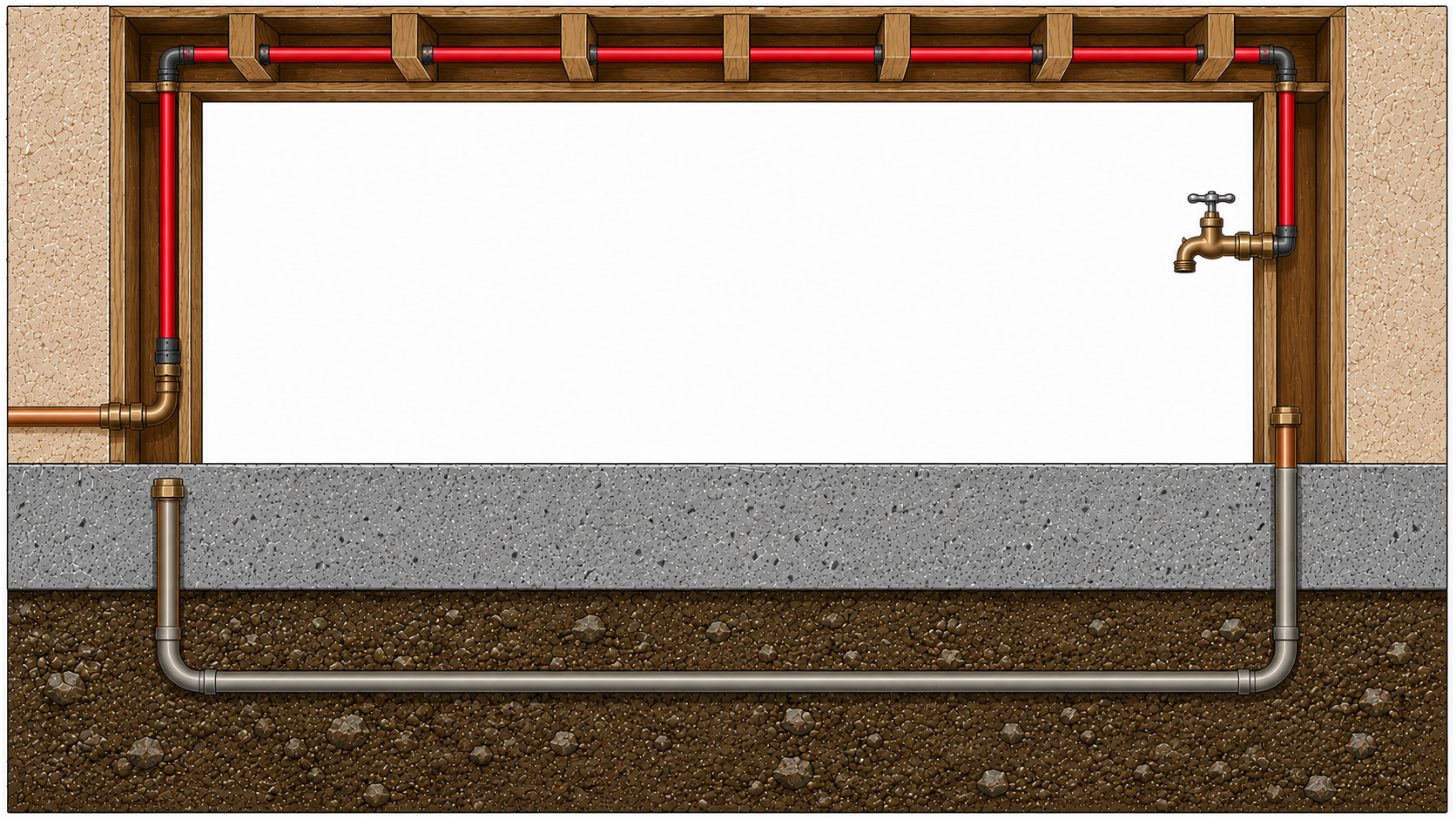
New line, run above the slab
New PEX goes up the wall, across the ceiling joists, and back down to the fixture. The old line stays capped and abandoned in the concrete where it can do no further harm. No saw, no vibration, no exposure for the rest of the run.
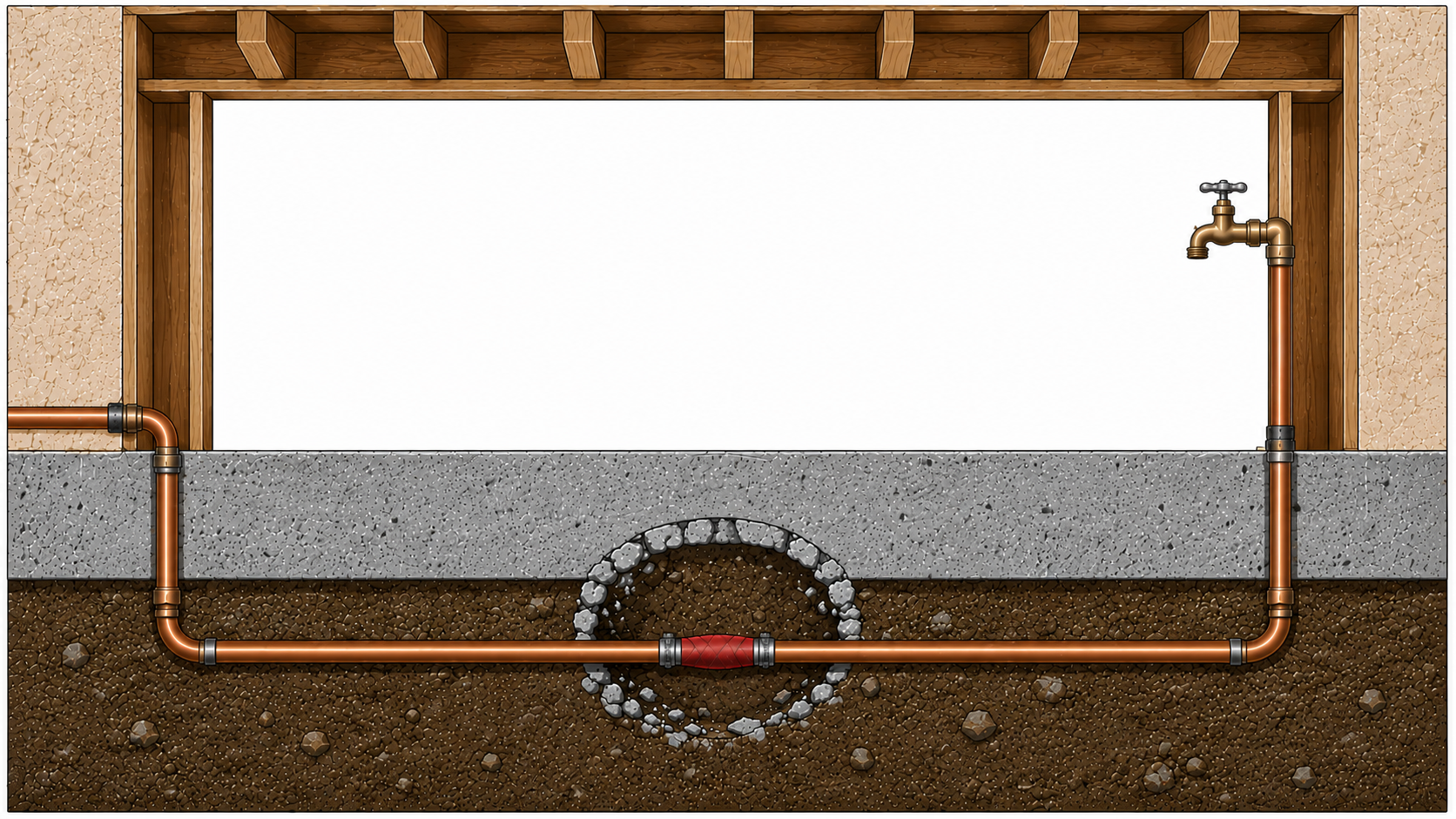
Cutting concrete to patch in place
Opening the slab to mend one section leaves every other foot of that aged copper exactly where it was, under the same conditions that finished off the first one. The demolition then adds a risk of its own to neighboring pipe.
Re-route the failing line overhead
For any pipe failure under the concrete, hot or coldA reroute takes the failed under-slab section out of service by running new PEX-A through the walls and attic and leaving the old copper capped in the concrete. The leak stops because that pipe stops carrying water. What makes it the right call is not tidiness, it is risk:
-
The rest of the run stops mattering Where one section of aged in-slab copper has gone, the neighboring sections are the same age in the same ground. A reroute retires the whole vulnerable line rather than the one hole you can prove.
-
No demolition near live pipe Concrete saws and jackhammers put vibration through everything they touch. A patch can solve today's leak and start next year's a few feet away. Bypassing removes that exposure completely.
-
Flooring is never lifted The work happens through two small drywall openings. No tile pulled, no concrete to re-pour, no finish carpentry to put back afterward.
-
It can be warranted New PEX carries a warranty on parts and workmanship. A patch on twenty-year-old copper does not, and no plumber should pretend otherwise.
-
It is the only safe option on a post-tension slab Where a home sits on post-tension foundations, cutting the concrete is not on the table at all. We treat conventional slabs to the same standard rather than keeping two sets of rules.
Accessible spot repair
When the leak is NOT in the slabA spot repair earns its place only when the leak turns out not to be buried at all. If we can reach the failure without touching concrete, we repair it there and then. The diagnostic tells us this well before any decision is needed.
-
At an exposed shutoff or angle stop Under a sink, behind a toilet, at the laundry box. The failing fitting comes out and a new one goes in.
-
At the water-heater connection A flex line, a dielectric union, or the heater inlet itself. All visible, all repairable with nothing opened.
-
In a reachable wall cavity A pinhole feeding a fixture through drywall rather than through the slab. One small cut, one section swapped, one patch.
-
Never through the slab If the diagnostic places the leak in concrete, the concrete stays closed and the line gets bypassed. That holds regardless of what the alternative would have cost.
If a plumber has offered to open your slab to patch one spot on aged copper, get a second opinion before you agree. On the numbers and on the risk, that call very rarely goes your way.
Our thanks to the people who keep Wildomar running..
A 5% discount (up to $200 off) for first responders, military, healthcare, teachers, seniors, and nonprofit staff serving Wildomar and Southwest Riverside County. Mention "Community Heroes" when you call our dispatch; we'll take care of the rest.
Applies to repairs over $500. Cannot be combined with other promotions. Proof of eligibility may be requested at the time of service.
Wildomar neighborhoods where we do slab work weekly.
Our dispatch is a short run down the I-15, so a technician is on a Wildomar driveway well inside the hour. Clinton Keith Road and Bundy Canyon Road carry us across the tract neighborhoods, and Palomar Street and Grand Avenue reach the older side of town.
Murrieta Office
Murrieta, CA 92562
Neighborhoods we service for slab leaks
The areas our trucks reach on a weekly basis. If you are close by and do not see your street, we still cover it, just call.
Slab leak specialists serving Wildomar since 2008.
Cali's Choice
Leak detection and slab leak specialists serving Wildomar and Southwest Riverside County.
Slab leaks repaired in the area
Spot repairs and overhead reroutes across Wildomar, combined.
California License
C-36 Plumbing classification. Bonded & insured statewide.
Leak detection
Free when we do the slab repair.
What homeowners say about our slab work.
Real reviews from our Google Business Profile.
Sergio and Levi were sent out after I suspected a slab leak, and they confirmed it. They did an amazing job re-piping the house and finished much faster than I expected. Very professional and courteous throughout.
Awesome service from John and his guys. We had a slab leak, it was detected and the repair was scheduled straight away. John and his son were respectful and left everything clean, and the price was fair.
A water leak under our slab was carefully fixed by Sergio and Levi. They worked for eleven hours straight so we could have running water that evening. Estimates were reasonable, repairs were explained, and the area was cleaned when the job was done.
We handle the slab-leak claim. You don't.
An HO-3 policy will rarely see a claim as heavily evidenced as a slab leak with water damage attached. Carriers want sudden and accidental cause of loss set out in writing, a line-itemed scope, and photographs of the pipe that actually failed. Miss one of those and the file sits untouched for weeks while the water carries on working.
So the claim becomes our job rather than yours. Not an invoice sent over with best wishes. Documentation, submission, and the adjuster conversation, all of it run by us.

- The cause set out formally. Sudden and accidental wording, which line failed and on which side, the year the house was built, and the pipe material.
- Complete photographic evidence. Locating data, the access point, the section of copper that failed, and the surrounding damage. Dated, ordered, and captioned.
- The scope itemized. Spot repair or reroute, priced line by line, with the diagnostic reasoning recorded against the recommendation.
- Carrier contact handled here. Your adjuster speaks to us. Pushback gets answered, requests for more evidence get met, and you stay out of it.
- Reroute justification when it matters. Carriers routinely approve slab spot repairs and challenge reroutes on aged copper. We document why the reroute is correct and back it with the diagnostic.








What Wildomar slab leak repair actually costs.
Straight answer: an exact slab leak repair cost cannot come off a website. The same job varies by a factor of three depending on what the diagnostic turns up, one line or several, one story or two, an attic you can stand up in or one you cannot. What we can set out is what drives the figure on a slab leak reroute, so the written quote reads as expected rather than as a shock.
What moves a slab job up or down
Reroute scope: one line or the whole house
A single-line reroute, typically one hot run from the heater out to a wing of the house, is the everyday job. Multi-line work and full PEX repipes build up from that baseline.
Pipe material & age
Copper laid in the late 1980s through the mid 2000s tends to fail as a run rather than at a point. Where that is what we find, the recommendation moves from one line toward a repipe, and we explain why on the day.
Run distance & attic access
How far the new line has to travel and how workable the attic is both feed straight into labor hours. Single-story tract homes are usually simple, two-story with a finished attic takes longer.
Number of drywall access cuts
Two small openings covers most reroutes. An awkward run occasionally needs a third. Patching and texture matching are quoted in from the start, not added afterward.
Water damage already present
Where the leak has already soaked drywall or flooring, that is a separate scope, dry-out and reconstruction, and it does not belong on a plumbing invoice. We document it for your claim.
How do I know whether my Wildomar home even has a slab?
A good share of housing here does not. Ranch properties on raised foundations and manufactured homes have their supply lines in a crawl space or underneath rather than cast into concrete, so a slab leak is not possible in them. If your home is a tract build from roughly the late 1980s onward, it is very likely slab-on-grade. One question on the phone usually settles which you have.
What does a slab leak feel like day to day?
Four signs come up again and again. A warm patch in one spot on the floor, which points at the hot line. A water bill that climbs sharply with no change in the household. The sound of water moving with everything shut off. And a meter that keeps turning after every fixture is closed. Any one on its own is worth a call.
Will you have to break my floor to fix it?
No. We do not cut slabs. Where a line inside the concrete has failed, we run new PEX overhead through the attic and leave the old copper capped where it lies. That means two small drywall openings, no flooring lifted, and no demolition vibration passing into the pipe that is still in service.
Does the soil around here really cause this?
It contributes. The valley floor under Wildomar is soft ground, sand and silt and clay, which takes on moisture through the wet months and dries out again in summer. That cycle moves the slab a little, year after year. On its own it would not break a pipe. Combined with copper that has been in the ground two decades, it is enough.
How fast can you get here for a slab leak?
Inside 60 minutes across Wildomar, at any hour. The city sits right on the I-15, so distance is not the obstacle it is in some places. If water is actively running, call and our dispatcher will get you to the shutoff while the truck is moving.
What is the difference between a spot repair and a reroute?
A spot repair only applies when the leak was never inside the slab, at a shutoff, a heater connection, or a wall run we can reach. For anything genuinely buried in concrete, the answer is a reroute. Patching a buried run leaves the rest of the same aged pipe in place, and the demolition needed to reach it can start the next failure.
My home is on a post-tension slab. Does that change your answer?
It removes the alternative entirely. A post-tension foundation carries steel tendons under tension through the concrete, and cutting into one is not something a plumber should be doing. An overhead reroute is the only responsible route. As it happens that is what we recommend on conventional slabs too, so in practice the answer is the same either way.
This is my second slab leak. Should I be worried?
Concerned rather than alarmed. A second failure on the same run is the point at which patching stops making sense, because it is telling you the run itself has aged out rather than that you were unlucky twice. That is usually when we recommend taking the whole line overhead instead of waiting for a third.
Will my insurance cover a slab leak?
Most HO-3 policies cover the sudden and accidental water damage, the wet drywall, the flooring, the dry-out and reconstruction that follows. The pipe repair itself is generally not covered. We document both halves so the adjuster gets a complete file, and the insurance section above explains how we run it.
Do you pull City of Wildomar permits, and can you bill my insurer?
It depends on the work. Larger reroutes and full repipes are often permitted through the City of Wildomar, while single-section and like-for-like repairs usually are not. We assess your job and tell you up front what is needed and what it costs. On billing, we work directly with most major carriers writing here: we submit the scope of loss and you cover your deductible.
Slab leak in your Wildomar home? We'll find it without opening the floor.
Local technician. Local truck. Written quote, spot-repair vs. reroute, before we touch a thing. If we can't help, we'll tell you who can.
26193 Jefferson Ave, Ste C · Murrieta, CA 92562 · CSLB #920054