
Water Leak Detection
You can tell there is a leak. What you can’t tell is where it is or what kind it is, and guessing is how floors get torn up for nothing. That is what detection settles first. We pinpoint hidden leaks behind walls, above ceilings, under fixtures, and inside pressurized copper, without opening a single surface, then show you exactly what the repair involves. Find it, then fix it, in that order, every time.
- 60-minute response
- 24/7 emergency line
- No demolition to locate
- CSLB #920054
Heads up: We’re water-line specialists. We don’t service pool/spa leaks, irrigation lines, or natural-gas lines. Everything else hidden behind walls, under sinks, or in the ceiling, that’s exactly what we do.
What is water leak detection?
Water leak detection is the non-invasive process of locating a hidden water leak, behind a wall, under a floor, above a ceiling, or inside a pressurized supply line, before any surface is opened. It works by elimination rather than excavation: a sequence of diagnostic tests, a meter reading, line isolation, acoustic listening through the pipe, and a pressure check, narrows the fault to one line and one area, so the repair that follows is targeted instead of exploratory. The point of detecting first is simple, you only open what the diagnostic tells you to.
No Callout Charge
Your service call is free. No trip charges, or surprise add-ons.
Always On Call
Nights, weekends, holidays, we are available around the clock. Burst pipe at 3am? No problem.
Written Estimates
No-obligation written quote. We walk you through every line item.
Six shapes a concealed leak takes, and how each one is put right.
A hidden leak shows up in a handful of recognizable forms. Locating runs first on all of them, since the failed line has to be pinned before any repair is more than a guess. Once it is, one crew carries the work through, from a single weeping joint to a whole run that has earned replacement.
Pinpoint locating
The read that opens every visit. Watching the meter, splitting hot from cold, tracing the sound along the pipe, and confirming on a pressure gauge tells us which line gave way and roughly where, with no surface disturbed. A thermal camera joins in only to settle a close call.
- Hot and cold lines checked under pressure
- Behind-drywall and attic-feed tracing
- Findings photographed for your claim
Behind-wall and overhead fixes
With the line pinned, we cut only where the read sends us: a tight opening to reach a weeping joint inside a wall, or a fix on a feed dripping down from the story above. Sparing the drywall around it is the point, not collateral we shrug off.
- Tight openings that protect intact board
- Overhead feed-line work
- Re-pressurized and checked before sealing
Tired copper and its weeping points
Thin copper that has carried hard pressure for decades begins to seep at tiny spots. We renew the spent stretch rather than the entire run, and hold off on more until the line itself signals it is finished.
- Spot tracing along copper runs
- Why-it-went read: pressure, chemistry, years
- Stretch renewal or a partial repipe
Shutoffs, fixtures, and feed lines
Seepage at an angle stop, beneath a sink, behind a toilet, at the laundry box, or along the line feeding any fixture. We trace each one back to its origin and correct it there, without test cuts to find it.
- Angle-stop and feed-line work
- Under-sink and fixture seepage
- Confirmed under pressure at close
When renewing the run beats patching
Once the same copper keeps seeping, the next patch is money chasing the last one. Swapping the spent stretches for PEX ends the cycle for good, and we say so plainly the moment the arithmetic turns against another repair.
- PEX standing in for spent stretches
- A frank repair-or-renew verdict
- Regulator pressure reviewed
Carrying the insurance file
We assemble the locating record, dated images, and a loss scope phrased the way an adjuster reads, drawing on years across every major homeowner policy. You are not left piecing the evidence together on your own.
- Documented cause of loss
- Carrier billing where permitted
- Scope written in carrier terms
How do you find a water leak without breaking anything?
You know there’s a leak, you just don’t know its kind or its place: in-wall, ceiling, pinhole, behind a cabinet, or a buried supply line. Detection is a process of elimination before it is ever a search. Each step is a yes-or-no test that cuts the possible fault area roughly in half, so by the time anyone listens for the leak itself, the question has narrowed from somewhere in the house to this line, this side, about here. We confirm a hypothesis, we don’t hunt blind, and that is the whole reason it can be done without opening a wall.
The order is deliberate, cheapest and least invasive test first, because each one rules out an entire category of problem before the next begins. Run it out of order and you are guessing with a saw. Run it in order and, by the time anything is opened, we already know the failed line and roughly where it sits. That is the difference between one access cut and a room full of demo.
Read the meter first
Before a tool comes off the truck, we watch the water meter with every fixture and appliance shut. The meter is a flow gauge on the whole-house feed, so it answers one question with no instruments: is this closed system holding or losing water? Still means it holds, and a leak is ruled out. Creeping means water is leaving the system, and only then is there a leak worth finding.
Inside the house, or outside it?
We close the main valve at the house. The main is the boundary between two completely different jobs, so settling the side first keeps us from chasing the wrong system. If the meter goes still, the loss is inside the home. If it keeps turning, it is in the service line or the irrigation outside, which we don’t repair, but we will tell you plainly what you are dealing with.
Hot side or cold side?
At the water heater we close the cold inlet. Starting here is playing the odds, not guessing: hot lines tend to fail first, because heat speeds copper’s corrosion and the constant expand-and-contract of hot water works the pipe against whatever holds it. If the leak signal eases, it is a hot-line leak; if it holds, it is cold. A warm floor is a hint, not proof, because a hot line doesn’t always warm the surface above it, so we trust the acoustic read over the bare foot.
Listen through the pipe, not the wall
This is the part most people picture wrong, and it is a method choice, not a preference. Drywall and concrete are dense, so they deaden and scatter a leak’s sound, and listening at the surface gives a smeared reading that points everywhere at once. The pipe is a continuous metal path that carries the leak’s hiss cleanly to any point we can reach, a shutoff, the heater, a hose bib, and because the sound travels along the metal it also tells us which line is carrying it. We read the material that conducts the signal, never the one that muffles it.
Confirm it under pressure
Acoustics can be fooled, by a noisy house, by more than one suspect on the line, so we never open anything on a single signal. We cap a gauge onto a hose bib, close the main, and watch the needle. A steady fall is a separate physics that proves the system is actively losing water no matter what we heard, and the speed of the drop estimates how fast. Two independent signals agreeing is what lets us cut one spot with confidence.
Add a thermal pass when it earns its place
Thermal reads surface temperature, which is only a proxy: it works on a hot-line leak under a conductive floor or wall and is easily thrown off by sun, appliances, or a radiant heat path. Lean on it as the primary locate and it will send you opening the wrong surface, so we keep it as a tiebreaker that confirms the acoustic read, never the thing a cut is based on.
What are the signs of a hidden water leak?
Hidden leaks rarely announce themselves. By the time water shows up somewhere you can see it, the leak has usually been running for weeks, often far from where it surfaces. These are the signs homeowners notice first, and, more useful, what each one is actually telling you about the leak underneath it.
You don’t need all six. Any single one is reason enough to call, because each points at a different failure and a different next test.
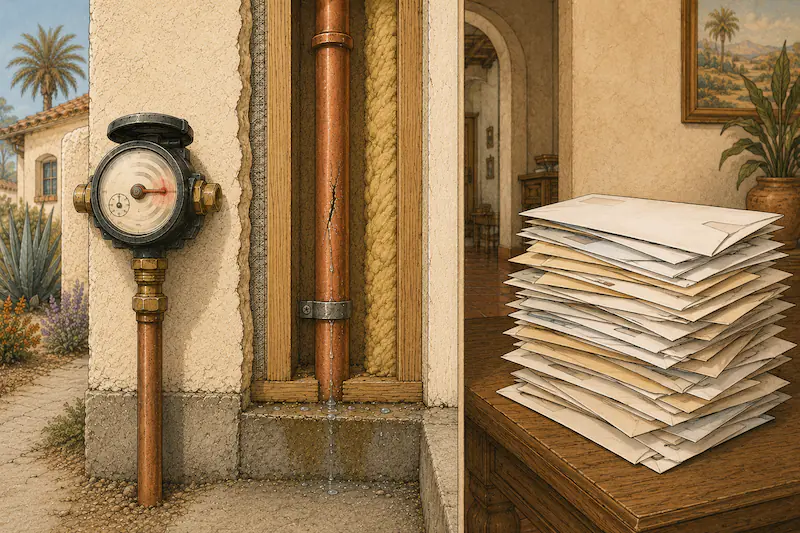
A water bill that climbs with no change in habits
A hidden leak runs every hour of every day, so the bill is really a running total of waste over time. That is why a drip too small to hear can still add hundreds of dollars a month: the size barely matters once you multiply it by twenty-four hours. If your usage hasn’t changed but the number keeps rising, the gap is water escaping before it reaches a fixture.
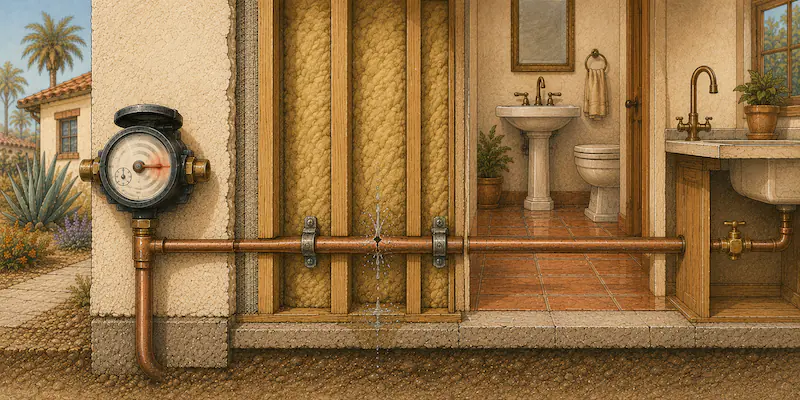
The meter moving with everything shut off
Turn off every faucet, appliance, and fixture, then watch the meter dial. It sits on the whole-house feed, so with nothing drawing water, any movement at all is unaccounted flow somewhere downstream of it. This is the single most definitive at-home check, and it is the first one we run, because it proves within minutes whether a leak exists before we spend time finding it.
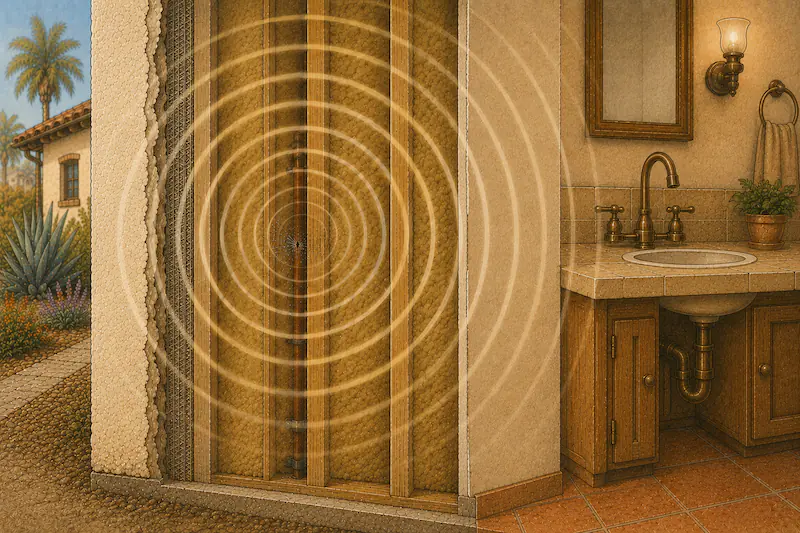
Running water you can hear with nothing on
A faint hiss, trickle, or rush behind a wall or under the floor is turbulence at the leak itself, water forcing through an opening it shouldn’t. You can hear that it is happening, but not where, because the pipe carries the sound away from the source along its whole length. The sound confirms the problem; locating it still takes listening at the pipe, not at the wall.
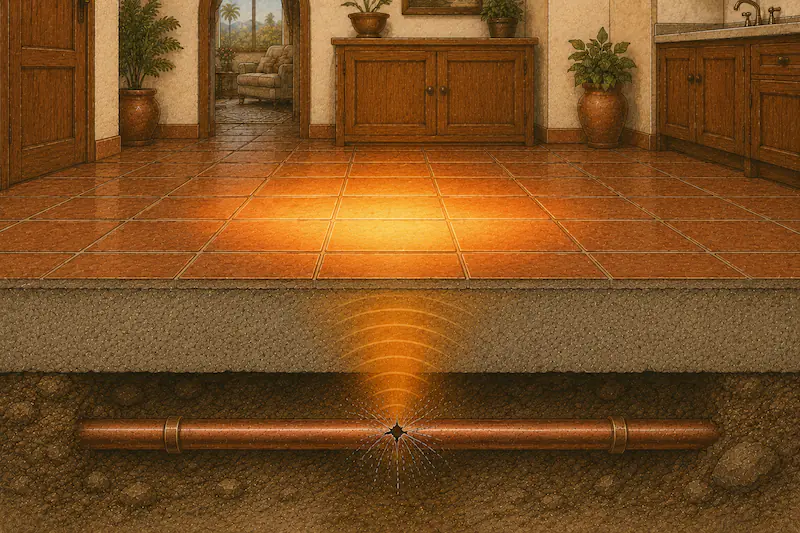
A warm patch on the floor
A spot warmer than the floor around it usually means a hot-water line is leaking below, with the heat conducting up through slab or flooring. Worth knowing: the reverse doesn’t hold. No warm spot does not clear a hot leak, because depth and floor type can hide the heat entirely. That asymmetry is exactly why we confirm the side acoustically instead of trusting what the floor feels like.
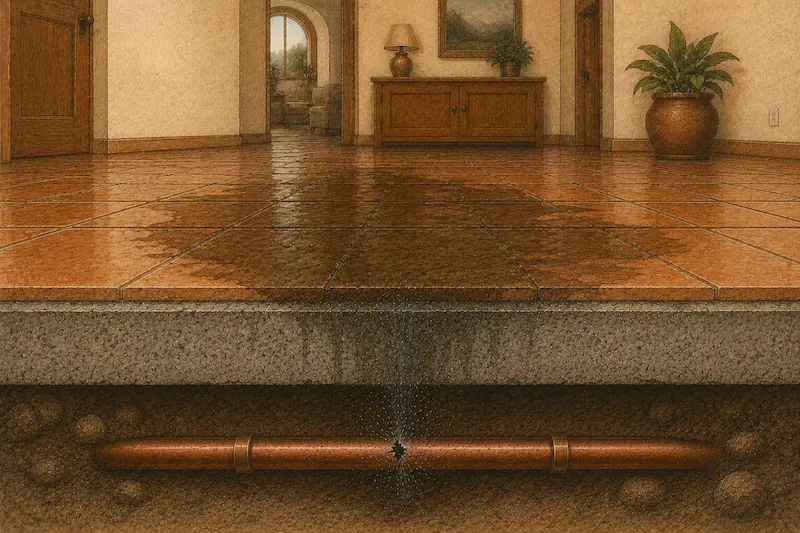
Damp flooring with no source nearby
Moisture in carpet, wood, or tile with no spill, fixture, or rain to explain it is water that has traveled. It follows the path of least resistance, so the wet patch is often a good distance from the actual leak. That is the trap in cutting where it looks wet: you can open the floor in the wrong place entirely, which is why the wet spot is a clue to investigate, not a target to dig.
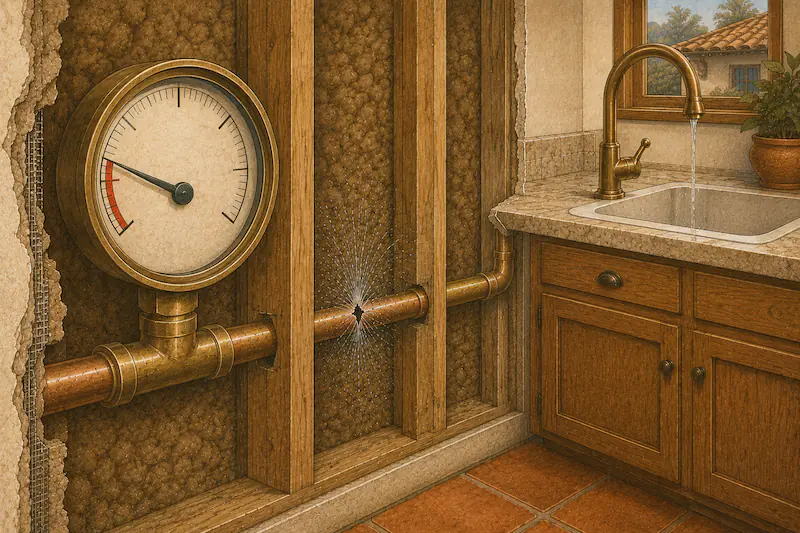
Water pressure that has quietly dropped
If shower and faucet pressure faded but nothing about your fixtures or service changed, water is likely bleeding out of the system before it reaches the tap. Leak-driven pressure loss comes on gradually, which is why it so often gets written off as old pipes instead of an active leak draining the line in the background.
Our thanks to the people who keep our communities running.
A 5% discount (up to $200 off) for first responders, military, healthcare workers, teachers, seniors, and nonprofit staff in the communities we serve. Mention "Community Heroes" when you call; we’ll take care of the rest.
- First Responders
- Military
- Healthcare Workers
- Seniors
- Teachers
- Nonprofit Employees
 First Responders
 Military
 Healthcare Workers
 Seniors
 Teachers
 Nonprofit Employees

Applies to repairs over $500. Cannot be combined with other promotions. Proof of eligibility may be requested at the time of service.
Water leak detection in your city
We dispatch from offices across Southern California. Pick your city for local response times, neighborhoods, and the team that serves you.
Cities served by our Murrieta office
Cities served by our Aliso Viejo office
Cities served by our Irvine office
Cities served by our San Diego office
Leak detection specialists since 2008.
Response window, day or night
Dispatch-to-driveway target for emergency calls, around the clock.
Hidden leaks located
Behind-wall, pinhole, ceiling, and supply-line leaks found and repaired.
California License
C-36 Plumbing classification. Bonded and insured statewide.
Leak detection
Free when we do the repair.
What homeowners say about finding hidden leaks.
Real reviews posted to our Google Business Profile.
I heard a leak in my wall and within two hours they had someone at my house. Sergio was awesome, found it fast and sorted it out.
Sergio came out on a Saturday evening for a leak in my ceiling. I was very pleased with the response time and the quick fix. I would definitely recommend these guys.
Great knowledgeable team. They found the issue and helped me find a resolution quickly. No guesswork, no mess.
A hidden-leak claim rests on evidence you can only capture once.
A hidden leak is, by its nature, something nobody saw coming, so the moment it is exposed is the one chance to document it. Once the wall is patched and the area dried, an adjuster has nothing left to assess but your description of it. The covered damage is usually granted; the friction lands on the repair, whether a patch or a full repipe on tired copper is the choice the carrier will pay for.
So we build the file at the point of detection, while the failed pipe and the moisture path are still open, then run it to the carrier ourselves, so the claim is decided on documented fact rather than reconstructed from memory after the wall is closed.

- Cause documented at the source. A hidden leak gives one window to record what failed and why, the pinhole, the line, the path the water took, before any of it is sealed back up and put beyond an adjuster’s reach.
- Sudden and accidental, set down in writing. Coverage turns on that finding, so the file states how the line failed and when: the difference between a paid claim and a wear-and-tear denial on old copper.
- Repair versus repipe, argued not assumed. When tired copper makes a repipe the smarter repair than another patch, the scope makes that case with the diagnostic behind it, so the lasting fix isn’t denied in favor of the cheaper one.
- The carrier conversation is ours to carry. We field the adjuster’s questions and evidence requests directly, so you are not relaying technical detail about a leak you never actually saw.
- A photo record that reads as proof. The locating data, the open access point, the failed line, and the finished repair, dated and captioned, so the claim is a documented sequence rather than a written description.








How much does water leak detection cost?
Two separate questions hide inside that one, and conflating them is why phone quotes are worthless. Locating the leak is its own piece of work, and it carries no charge when we go on to carry out the repair. What the repair comes to cannot be known until the locating has finished, because one symptom, a damp skirting or a climbing bill, resolves either to a ten-minute fitting change or to a day of pipework. Set out below is what decides which of those you have.
The five things that settle the number
Diagnosis and repair are priced apart
Locating is a defined scope with a defined outcome: the failed line, named. Only once that exists does anyone know what the second scope involves, so it is quoted second, never bundled into a guess made before arrival.
Whether the failure can be reached at all
Something weeping at an exposed valve or a heater connection is a short visit. The same failure sitting behind stone, beneath a finished floor, or in the middle of the building is a different proposition before any plumbing begins.
One weak point, or a run that has aged out
A single failure on otherwise sound pipe is a section swap. Thinning showing along the length says the run itself is finished, and replacing it costs more now and less over the following decade.
What has to come apart, and go back
Hard flooring, upstairs rooms, cramped roof space and recently decorated interiors all add hours at both ends of the job. Making the surface good again is quoted with the work, not presented afterwards.
Whether the water has already caused harm
Drying out and rebuilding is a separate scope from plumbing, handled by a sister company. We record it properly so your claim can carry it, and we keep it off our own figure.
Can I test for a hidden leak myself before calling a plumber?
Yes, in two quick checks. Shut off every faucet and appliance, then watch the small leak dial on your water meter. If it turns, water is escaping. Next, drip food coloring into each toilet tank and wait without flushing. Color in the bowl points to the toilet. If both checks raise questions, call us.
Why is leak detection free when you do the repair?
Because finding the leak is the first half of the same job. When you hire us to fix it, the locating costs nothing. You get the failed line named and a written repair quote before you decide. That way you aren’t paying twice, once to find the leak and again to fix it.
What causes pinhole leaks in copper pipe?
Usually slow wear from the inside. Water chemistry, fast flow and high pressure can pit the pipe wall over many years until a hole the size of a pin opens. A poor solder joint or a nick from construction can start one sooner. One pinhole often means the pipe around it is thin too, so we test the whole run.
Can a hidden leak stop and start?
Yes. Some leaks only open when pressure rises at night, when the water heater refills or when a fixture runs. That makes them hard to catch. With the main shut, we watch a gauge on the supply, which shows a loss even when it’s small and slow. Drain leaks that appear only with use get tested on their own.
Is a high water bill always a sign of a leak?
No. Bills rise with more people at home, a new appliance, a rate change or a summer of heavy watering. Compare your use in gallons, not dollars, with the same month last year. If use is up for no reason, check the meter with everything off. A dial that keeps moving is what points to a leak.
How much drywall will you cut to fix a leak inside a wall?
Only what the repair needs. Since the failed line and spot are named before any cut, we open one small section where the pipe is, not a row of test holes. Patching that opening is written into the quote. If the leak is behind tile or cabinets, we go over the access options with you first.
What should I do while I wait for the leak detection visit?
Note what you’ve seen and when: the stain, the sound, the bill. Snap a photo of the meter reading. Keep the water on unless water is spreading, because a line under pressure is easier to trace. Clear a path to the water heater, the meter and any sinks near the problem so the testing goes quickly.
Can you find leaks behind a tiled shower or kitchen cabinets?
Yes. Those are some of the hardest places to open, which is why the line gets found first. We test the supply under pressure and listen on the pipe at nearby valves. When access is needed, we plan the opening with you, such as through the back of a cabinet or a closet wall instead of the tile.
What if the leak turns out to be outside the house?
Then it falls outside what we repair. We don’t work on pool, spa, irrigation, sprinkler or gas leaks. If the meter keeps moving with the house main closed, the loss is outdoors, and we’ll tell you so plainly. A landscape or pool specialist is the right call for that repair.
How do I choose a leak detection company?
Ask how they find the leak. A specialist should test the lines and locate the failed pipe before opening walls, not cut and hope. Ask for a written quote before work, whether detection is free with the repair, and the license number. Ours is CSLB 920054, and we’ve done this work since 2008.
Suspect a hidden leak? We find it before we fix it.
A specialist, a written estimate, and a clear picture of the repair before we open anything. If we can’t help, we’ll tell you who can.
Cali's Choice Leak Detection & Emergency Plumbing · CSLB #920054